
One Satellite Link. Your Entire Team Connected.
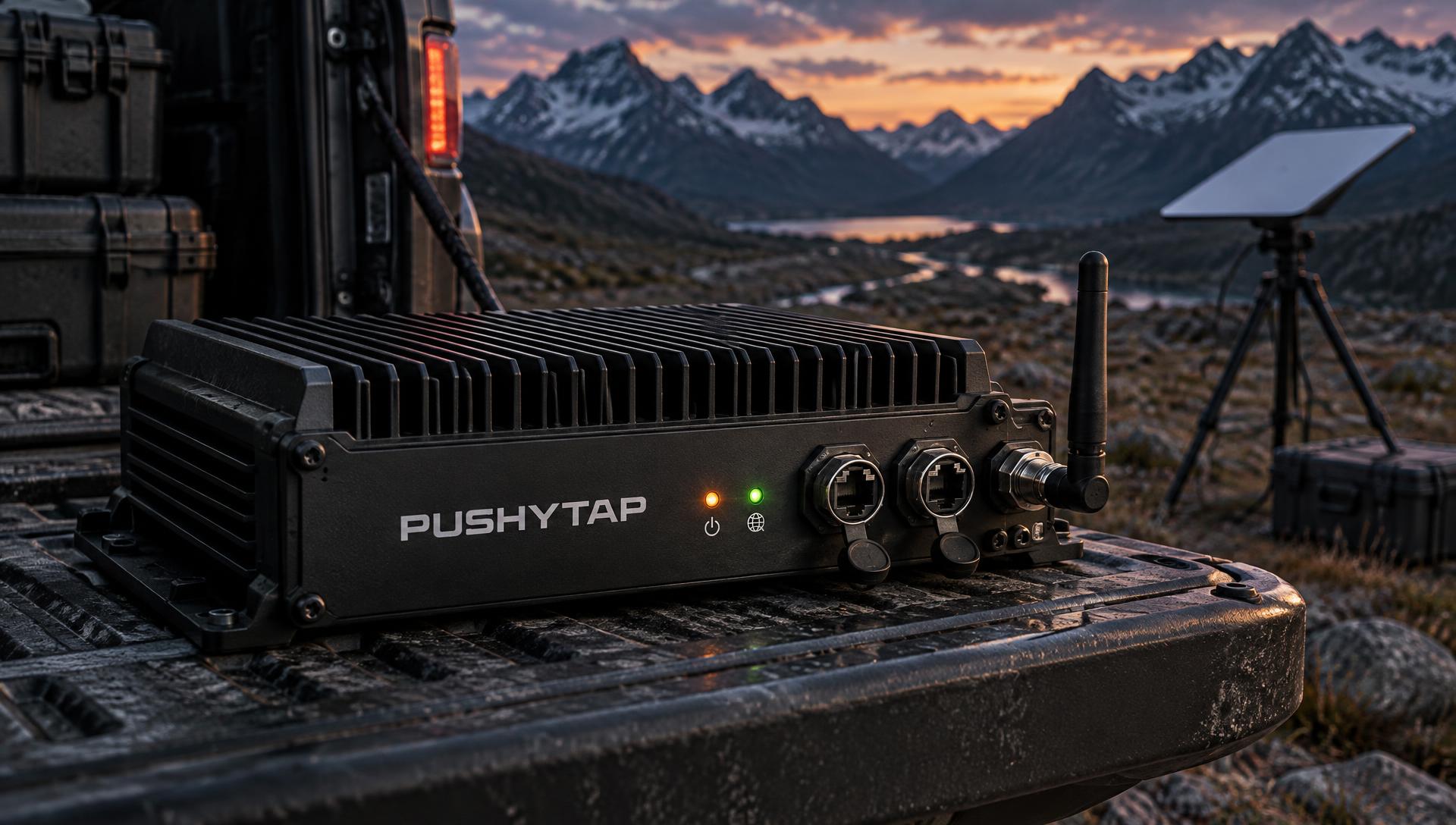
Connect up to 64 field handsets through a single satellite or mobile terminal. The Pushytap Field Node de-duplicates voice traffic to slash satellite airtime costs, while maintaining instant on-site team communications even when satellite backhaul is blocked.
Executive value
Built for the economics and realities of satellite operations.
Airtime Economics That Scale With Your Team
Problem
Standard satellite PTT sends a separate audio stream down to every single radio. 8 handsets listening to one transmission will saturate an 88 kbps satellite terminal and generate punishing airtime bills.
Solution
The Pushytap Field Node receives transmissions once over the satellite connection and fans them out locally over Wi-Fi, Ethernet, or tactical mesh. Your satellite data usage stays flat whether you have 2 people listening or 50.
Continuous On-Site Communications
Problem
Dense tree canopy, deep terrain, tropical rain fade, or vehicle motion frequently occlude satellite connections, leaving mobile crews isolated.
Solution
If satellite connectivity drops, the Field Node immediately activates an autonomous local voice channel. Crew members within range continue communicating with instant local radio responsiveness.
Intelligent Multi-Bearer Traffic Prioritization
Problem
Field teams often deploy multiple connections (cellular, Starlink, L-band satellite) without an automated way to manage cost and voice reliability.
Solution
Pushytap dynamically prioritizes mission-critical PTT voice and emergency SOS alerts across your most reliable active connection, while routing heavy data, logs, and media uploads across available broadband links.
How it works
From the handset to command, over one link.
- Step 01
Crew Handsets & Radios
Android rugged handsets, mobile apps, and RoIP-bridged radios join the Field Node via standard local Wi-Fi, private LTE, or tactical mesh.
- Step 02
Pushytap Field Node Edge Gateway
Arbitrates local transmission queues, packetizes voice into optimized low-bandwidth streams, and de-duplicates all inbound audio.
- Step 03
Satellite Backhaul (LEO / GEO / Cellular)
Transmits single-stream encrypted packets over any connected field terminal (Starlink, Iridium Certus, Inmarsat, or high-gain cellular) to Pushytap Cloud.
- Step 04
Pushytap Cloud & Operations Command
Centralized dispatch, audit logging, multi-site talkgroups, and enterprise safety escalation remain unified across the enterprise.
Specifications
Hardware specifications & deployment profiles
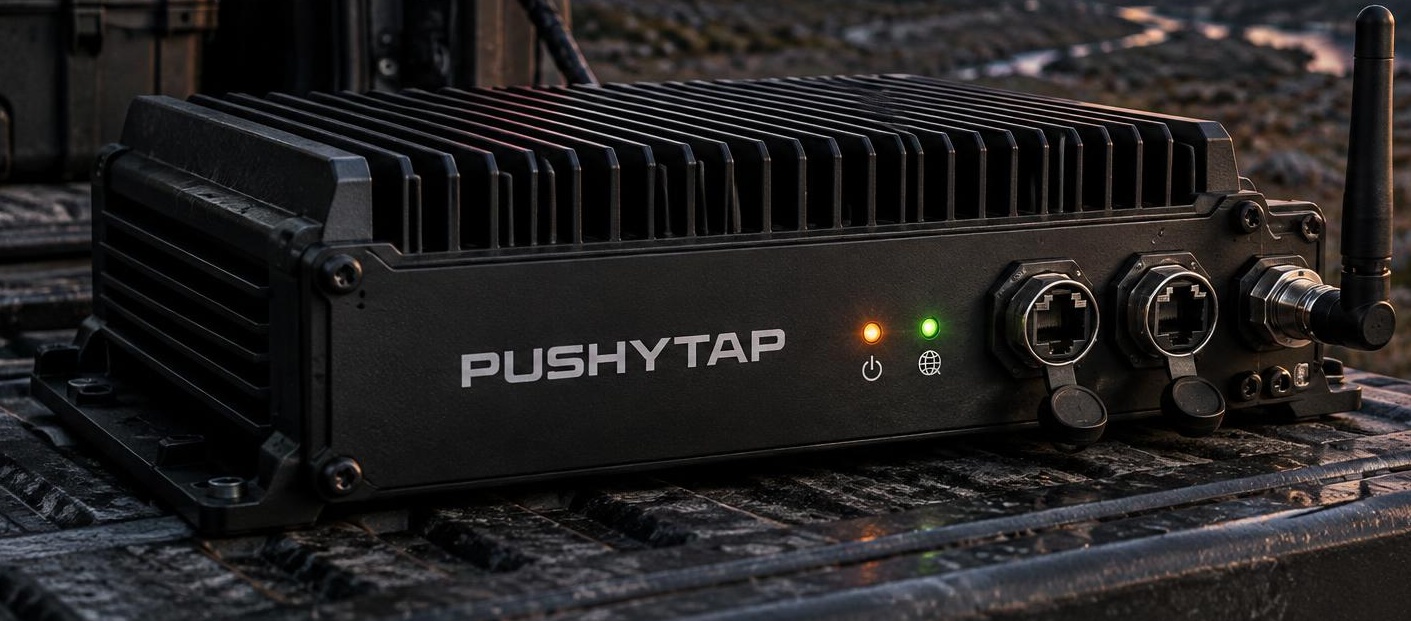
| Specification | Field Node Mobile (Vehicles & Flyaway Kits) | Field Node Base (Base Camps & Fixed Facilities) |
|---|---|---|
| Primary Deployment | Vehicle mounts, mobile patrols, rapid-deploy kits | Field offices, base camps, remote substations |
| Active Radio Capacity | Up to 16 concurrent field endpoints | Up to 64 concurrent field endpoints |
| Local Connectivity | Wi-Fi 6 AP, 1× Gigabit Ethernet, 2× USB | Wi-Fi 6 AP, 2× Gigabit Ethernet, 4× USB |
| Power Input | 9-36V DC (Vehicle / Solar Battery) | 12-48V DC, PoE+ (802.3at), or AC Adapter |
| Power Consumption | 10-15W Average | 15-25W Average |
| Enclosure Rating | IP66 Rugged, Sealed Fanless Aluminum | IP65 Heavy-duty Industrial Wall/Rack Mount |
| Operating Temperature | -20°C to +55°C | -20°C to +55°C |
| Mounting Options | Vehicle bracket, MOLLE field pack | 19" Rack shelf, wall/DIN rail mount |
| Data Protection | Hardware-backed cryptographic keys, encrypted local cache, automated data timeout | Hardware-backed cryptographic keys, encrypted local cache, automated data timeout |
Security
Security & enterprise governance
Hardware-Bound Trust
The appliance authenticates against Pushytap Cloud using cryptographic hardware certificates. Unauthorized devices cannot tap into local site streams.
Preserved Operator Identity
Audio forwarded through the node preserves the individual field worker's identity, ensuring that dispatch logs, compliance records, and recordings accurately identify the speaking operator.
Automated Data Safeguards
Local audio spools and operational caches are encrypted at rest. For expeditionary high-threat operations, automated data timeouts ensure that detached equipment purges cached data if separated from command networks beyond authorization thresholds.
Frequently asked questions
Does the Field Node replace Pushytap Cloud?
No. Pushytap Cloud remains the central floor arbitrator and management authority for all wide-area talkgroups, dispatch consoles, and fleet audit trails. The Field Node acts as an edge gateway on site. It manages the satellite or cellular link, cuts bandwidth use, and keeps local voice running if that link drops.
Can Starlink be our primary satellite link?
Yes. The Field Node supports standard Ethernet/IP uplinks. You can deploy Starlink as your primary broadband carrier, with secondary cellular or L-band satellite connections for resilient backup.
What happens to wide-area talkgroups during satellite occlusion?
If the satellite view is blocked by dense canopy or terrain, the node clearly indicates local-only mode to the crew. Crews on site keep talking to each other with no interruption. When the uplink recovers, the node reconciles status with Pushytap Cloud without replaying old talk bursts as live audio.
How much solar power is needed for remote operation?
The fanless design draws about 10-15W, so a mobile node paired with a standard satellite terminal can run 24/7 on a compact ~150W solar panel and a 1 kWh lithium (LiFePO4) battery bank.
Deploy Edge Voice to Your Remote Operations.
Speak with our systems engineers to calculate satellite bandwidth savings and tailor hardware packages for your field teams.